

Rainbow Six Siege ranks look simple from the outside. Eight metal and gem names, a number next to each, and a badge that changes when you win enough. Underneath, though, the ranking system has rules that confuse even experienced players, especially after the Ranked 3.0 overhaul and the arrival of the Legend Division.
This is the complete reference. You’ll find every rank and division, how Rank Points move you between them, how placements, squad limits and the Demotion Shield work, what it takes to reach Legend, and how today’s system grew out of the older ones. Where Ubisoft hasn’t published a detail, we’ll say so plainly rather than guess.
All facts about Rainbow Six Siege ranks here reflect the current season at the time of writing, Year 11 Season 3, Operation Split Fire. Rules can shift between seasons, so check the latest patch notes before you plan a big climb.
Rainbow Six Siege ranks at a glance
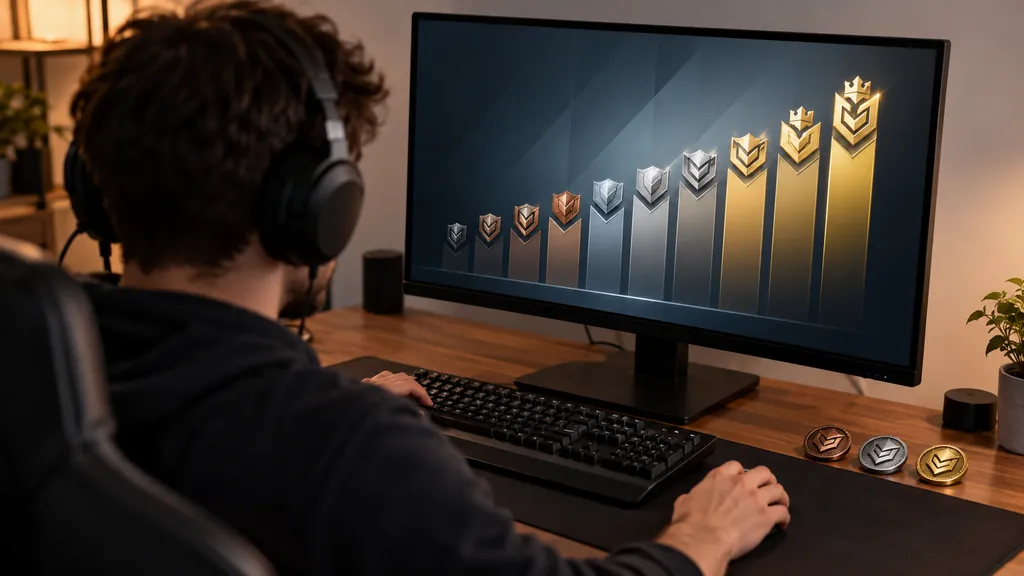
The current ranking system has 8 ranks, each split into 5 divisions. That gives 40 divisions from the bottom of Copper to the top of Champion. Above that sits the Legend Division, a separate tier for the very top of the ladder.
The eight rank tiers, from lowest to highest, are:
- Copper
- Bronze
- Silver
- Gold
- Platinum
- Emerald
- Diamond
- Champion
Those rank names come from Ranked 2.0. The big structural change in Ranked 3.0 is that Champion now has 5 divisions, matching every other rank. Before that, Champion worked differently from the rest of the ladder, so older guides describing an open-ended Champion tier are out of date.
One more access note. Ranked isn’t part of Free Access. You need a paid edition and player level 50 before Rainbow Six Siege ranks unlock for you, while Quick Match, Unranked and Dual Front are open to free players.
How the ranking system works in Ranked 3.0
Ranked 3.0 went live with Y11S2 Operation System Override in June 2026. Ubisoft explained the changes in its Ranked 3.0 announcement, and the core idea is simple. Your rank is your skill, with nothing hidden behind it.
Rank Points drive everything
You gain Rank Points (RP) for wins and lose them for losses. Hidden MMR is gone, and matchmaking now uses Rank Points only. Ubisoft’s post says RP changes depend on the match result and the relative rank of the teams. Beating stronger opponents earns more, and losing to lower-ranked teams costs more.
What Ubisoft hasn’t published
Under Ranked 2.0, Ubisoft did publish that each division consisted of 100 RP. Ubisoft hasn’t published Ranked 3.0 thresholds in the announcement, and it hasn’t given a per-match point formula either. Be cautious with any site quoting exact RP cutoffs for the current ranking system. The safe approach is to watch your own post-match reports.
The post-match report
After every Ranked match, the post-match report shows how many Rank Points you gained or lost. It’s the most reliable place to watch the ranking system in action, because it’s the game reporting on itself.

Every rank tier explained
Here’s how the rank tiers fit together, with the practical rules that apply at each level. Squad limits come from Ubisoft’s Ranked 3.0 post. We don’t include RP cutoffs or population percentages, because Ubisoft hasn’t published current figures for either.
| Rank | Divisions | Squad limit | Worth knowing |
|---|---|---|---|
| Copper | 5 | Within 3 full ranks | The starting tier of the ladder |
| Bronze | 5 | Within 3 full ranks | Fundamentals and map knowledge pay off fast |
| Silver | 5 | Within 3 full ranks | Utility use starts separating teams |
| Gold | 5 | Within 3 full ranks | Communication matters more each division |
| Platinum | 5 | Within 3 full ranks | Season 2 Platinum counts toward Legend entry |
| Emerald | 5 | Within 3 full ranks | Added in Ranked 2.0, between Platinum and Diamond |
| Diamond | 5 | Within 2 full ranks | Tighter squad rules begin here |
| Champion | 5 | Within 2 full ranks | Now 5 divisions; gateway to Legend |
Lower rank tiers, Copper to Silver
The lower Rainbow Six Siege ranks are where the game’s fundamentals get tested hardest. Every player passes through these rank tiers or starts somewhere near them, and the habits you build here carry all the way up. Holding angles, learning callouts, not peeking the same spot twice. Ranked results here move with consistency more than mechanics. If you’re in these rank tiers, map knowledge and simple utility habits tend to pay off faster than aim training.
Middle rank tiers, Gold to Emerald
In the middle rank tiers, coordination starts to decide rounds. Individual aim still matters, but the ranking system increasingly rewards teams that play together. Drones before entry, trades on the second man in, reinforcements placed with a plan. Emerald was added between Platinum and Diamond in Ranked 2.0, giving this part of the ranking system an extra step that splits a once-crowded band.
Top Rainbow Six Siege ranks, Diamond and Champion
At Diamond and Champion, the squad limit tightens from 3 full ranks to 2. That keeps lobbies more even, but it also means some friends drift out of range as you climb. At these Rainbow Six Siege ranks, small mistakes get punished quickly, so consistency becomes the main skill. Champion’s switch to 5 divisions makes progress at the top easier to read, since it now behaves like every other rank in the ranking system.
The Legend Division above Champion
The Legend Division launched with Y11S3 Operation Split Fire, according to Ubisoft’s official season list. It replaced the featured Champion leaderboard and sits above the 40 regular divisions as the top level of Rainbow Six Siege ranks.
To enter Legend, Ubisoft lists three requirements:
- Rank history. Platinum or higher in Season 2, and Champion in Season 3.
- R6 ShieldGuard Secure Platform. The anti-cheat setup introduced under the R6 ShieldGuard name with Siege X.
- App-based 2-Step verification. Ubisoft specifies the authenticator app method for this tier, so check which method your account uses.
The security requirements make sense for the top of the ladder. If you’re aiming for Legend, set up app-based 2-Step verification on your Ubisoft account well before the season gets serious. It’s a good idea for every player anyway.
Legend is also a moving target over a season. Because it replaced the featured Champion leaderboard, think of it as the place where the very best players in the ranking system are separated from the rest, rather than a ninth rank with the same rules as the others.
Placements and the start of each season
Each season you play 5 placement matches. They give boosted RP gains and have no squad restrictions, so you can queue with friends of any rank. Ubisoft says the boost helps players get back toward the level they reached in the previous season more quickly.
Placements are a Ranked 3.0 feature of the ranking system in their current form. Ranked 2.0 had actually removed placement matches, along with the old squad MMR restriction, so if you came back after a long break, this is one of the bigger differences in the ranking system you’ll notice.
A practical tip. Play your placements when you’re fresh and focused, not at the end of a long night. The boosted gains work in your favor only if you win, and early results set the tone for the weeks after.
It also helps to write down where you finished last season before your first placement game. That gives you a fair benchmark. If you land a little below it after five matches, that’s not a disaster, since normal Ranked play continues from there and the rank tiers are only a starting point for the season.
Squad limits and the Demotion Shield
Two rules shape day-to-day Ranked more than anything else in the current ranking system. Both affect how you move through the rank tiers, and both are easy to misunderstand.
Squad limits by rank tier
Copper to Emerald players can queue with teammates within 3 full ranks. Diamond and Champion players are limited to teammates within 2 full ranks. “Full ranks” means whole rank names, not divisions, so think in terms of Gold versus Diamond rather than Gold 2 versus Gold 4. Placement matches ignore these limits.
How the Demotion Shield protects you
The Demotion Shield stays in Ranked 3.0. If a loss would drop you out of your division, and you started that match above 0 RP, the game can leave you at 0 RP in your current division instead. It gives you one more chance, but it doesn’t make you immune. Start a match at 0 RP and lose, and you can drop.
If you keep landing on 0 RP, take that as a hint. You’re sitting on the edge of your division, and a short break or a switch to Unranked for a few games can save a frustrating slide down the Rainbow Six Siege ranks.
Rainbow Six Siege ranks on PC and console
Rank is shared only between similar platforms. Your highest console rank applies across PlayStation and Xbox, and PC rank is kept separate. Ubisoft’s cross-progression page lists rank, rank history and skill rating as shared only between similar platforms.
PC and console cross-play arrived with Y9S4 Operation Collision Point. Console players can choose to join the PC pool, but PC players can’t join console pools. When console players play Ranked in the PC pool, they keep a PC rank separate from their console rank. So one person can legitimately hold two different Rainbow Six Siege ranks at once.
Ubisoft has required 2-Step verification for Ranked on PC, so PC players should have it switched on before their first match of the season.
How the ranking system changed over the years
Understanding the history of the ranking system explains a lot of outdated advice still floating around. Rainbow Six Siege ranks have been rebuilt more than once since the game launched in 2015.
- Before Ranked 2.0. Your visible rank was tied to MMR, and the system used placement matches and a squad MMR restriction.
- Ranked 2.0, Y7S4 Operation Solar Raid. Ubisoft’s post is dated December 8, 2022. Rank came from Rank Points, and the old MMR became a hidden “skill” value used for matchmaking. Emerald was added, and placements and the squad MMR restriction were removed. Ubisoft published that each division was 100 RP.
- Ranked 3.0, Y11S2 Operation System Override, June 2026. Hidden MMR removed, matchmaking on Rank Points only, 5 placement matches back with boosted gains, Champion at 5 divisions, new squad limits.
- Legend Division, Y11S3 Operation Split Fire. A new top tier replacing the featured Champion leaderboard.
If a guide mentions your “hidden MMR”, 100 RP per division or an open-ended Champion tier, it’s describing an older ranking system. Our explainer on how skill rating and MMR worked covers that history in more depth.

Which modes count toward Rainbow Six Siege ranks
Only Ranked matches move your rank. That sounds obvious, but plenty of players wonder why a great night in Quick Match didn’t change anything. The ranking system ignores casual playlists completely, so your rank tiers only reflect games played in the Ranked queue.
Here’s how the main modes relate to Rainbow Six Siege ranks:
- Ranked. The only mode that uses Rank Points, placements, squad limits and the Demotion Shield. Needs a paid edition and player level 50.
- Unranked. Same competitive rules as Ranked, but no Rank Points at stake. It’s the best place to practice for the ranking system without risk.
- Quick Match. Casual, faster games. Good for warming up and trying new operators, with no effect on rank tiers.
- Dual Front. The permanent 6v6 respawn mode on District, available on PC, PS5 and Xbox Series X|S. Fun, but separate from Ranked.
A smart routine uses all of them. Warm up in Quick Match, learn a new map or strategy in Unranked, then queue Ranked when you’re sharp. If a Ranked session starts going badly, dropping back to Unranked keeps you playing without risking your place in the rank tiers.
Siege Cup is also gated behind the same requirements as Ranked for players who upgrade from Free Access, so if you’re not yet at level 50, use the casual modes to get there while you learn the maps.
Tracking your place in the rank tiers
Knowing the rank tiers is one thing. Knowing where you stand among Rainbow Six Siege ranks and how you’re moving is another. The simplest method is to note your rank, division and Rank Points after each session, using the post-match report as your source.
Our free Siege Tracker season tool lets you type those numbers in and save snapshots. It shows rank progress, session changes and trend charts, and the data stays in your browser. For a closer look at checking a single result, see our guide to the Rainbow Six Siege rank tracker and post-match RP report, and for session-by-session point logs, read the R6 RP tracker guide.
Curious how players spread across rank tiers? Ubisoft hasn’t published current population figures, but our R6 rank distribution guide explains what is and isn’t known, and the leaderboards and stats explorer has stat cards for each tier.
Rainbow Six Siege ranks FAQ
How many Rainbow Six Siege ranks are there?
There are 8 ranks: Copper, Bronze, Silver, Gold, Platinum, Emerald, Diamond and Champion. Each has 5 divisions, which makes 40 divisions in total. Above Champion sits the Legend Division, which launched with Y11S3 Operation Split Fire and replaced the featured Champion leaderboard.
How many RP do you need to rank up in Ranked 3.0?
Ubisoft hasn’t published Ranked 3.0 thresholds in the announcement. Under Ranked 2.0, each division was 100 RP, but that applied to the older ranking system. Watch your own post-match reports and note your Rank Points each time you cross a division.
What is the highest of the Rainbow Six Siege ranks?
Champion is the highest of the eight regular ranks, with 5 divisions. The Legend Division sits above it. Entry needs Platinum or higher in Season 2 and Champion in Season 3, the R6 ShieldGuard Secure Platform, and app-based 2-Step verification.
Can I play Ranked with friends of any rank?
Not always. Copper to Emerald players can queue with teammates within 3 full ranks, and Diamond and Champion players within 2 full ranks. Placement matches have no squad restrictions, so the first five games of a season are the time to play with anyone.
Does the Demotion Shield stop me from deranking?
Sometimes. If a loss would drop you a division and you started that match above 0 RP, you can stay at 0 RP in your current division. If you start a match at 0 RP and lose, the shield won’t save you.
Climbing the rank tiers with a plan
The ranking system rewards wins, consistency and smart squad choices. It doesn’t reward volume for its own sake, and it doesn’t care how many kills you got in a loss. Learn the rules above, play placements when you’re sharp, watch for repeated Demotion Shield saves, and keep a simple log of your progress. That combination does more for your climb than chasing any single number.
For older background, our rank system explainer is still useful history. Siege Tracker is independent and not affiliated with Ubisoft, and we never ask for your password. Open the season tool, save your current rank, and start tracking your way up the Rainbow Six Siege ranks.