Siege Tracker explains how Rainbow Six Siege leaderboards work and how to read rank, K/D and win rate in context. The cards below cover Ranked 3.0 rank tiers, player roles and core metrics, not live rankings. To check your own numbers, use the Stat Analyzer.
Platforms Covered
3
Rank Tiers
8
Stat Cards
20
Siege Player Stat Cards
20 cards on Ranked 3.0 rank tiers, roles and core metrics. Click any card for the full breakdown
This page explains how R6 leaderboards work in Rainbow Six Siege under Ranked 3.0 and how to compare players with care. The cards above are reference guides, and every number you analyze is one you enter yourself.
Reference, Not Live
The cards on this page explain rank tiers, roles and core metrics. They are reference guides, not a live ranking of real accounts, so check real standings in-game.
Leaderboard Filters
Leaderboards are usually split by Platform, Rank, Metric and Season. Reading results through those four filters keeps every comparison like for like.
Rank & RP Rules
Learn how Rank Points alone set ranked position under Ranked 3.0, and why beating stronger teams moves you up faster.
Fair Comparisons
Compare players on the same platform and season with a solid sample of ranked matches, so K/D and win rate tell an honest story.
Reader-Entered Stats
Enter your own kills, deaths, wins and losses in the Stat Analyzer. Calculations run in your browser and nothing is stored or sent.
Platform Context
Each platform has its own player pool and ranked tables. We explain how to read stats on PC, PlayStation and Xbox side by side.
Player Comparison Analyzer
Enter two players’ numbers from their in-game stats screens to compare them side by side.
Player ComparisonTwo sets of numbers, side by side
Enter both players' numbers. Compare players on the same platform and season, with a similar number of matches.
Enter numbers from your in-game career or ranked stats screen. Results are calculated in your browser — nothing is saved or sent anywhere.
How R6 Leaderboards Work
What leaderboard position means, how rank and RP feed into it, and how to compare players fairly.
How Rainbow Six Siege Leaderboards Work
Rainbow Six Siege leaderboards rank players by a chosen measure, usually ranked standing, and split results by platform and season. A leaderboard position is a snapshot: it shows where a player sits at one moment in the current season, not their full skill history. Siege Tracker does not run a live leaderboard. The cards on this page are reference guides to Ranked 3.0 rank tiers, player roles and core metrics, not live standings.
To see real standings, check the ranked screen in-game or your Ubisoft profile, and note which platform and season you are looking at. PC, PlayStation and Xbox players are normally ranked separately, and every new season starts a fresh table. When you want to read your own numbers, copy kills, deaths, wins and losses from your career screen into the Stat Analyzer or the K/D & Win Rate Calculator.
How Rank and RP Shape Position
Ranked position is driven by rank and Rank Points (RP). Ranks run Copper, Bronze, Silver, Gold, Platinum, Emerald, Diamond and Champion, and every tier, Champion included, has five divisions from V to I. Ranked 3.0 removed hidden MMR, so matchmaking uses RP only. RP changes after every match based on the result and the rank balance of both teams: beating stronger teams earns more, losing to lower-ranked teams costs more. K/D and win rate do not set leaderboard order directly, but they help explain it.
How to Compare R6 Players Fairly
Comparing two players fairly takes more than putting their numbers side by side. Start with sample size: a K/D from 20 ranked matches can swing a lot, while 150 or more matches gives a steadier picture. Compare players on the same platform, because input methods and player pools differ between PC, PlayStation and Xbox. Match the season as well. Seasonal stats show current form, while lifetime stats mix old and recent play and can hide improvement.
Role matters too. An entry fragger often has more deaths and a lower K/D than an anchor, yet may win more rounds for the team. Read K/D alongside win rate, headshot % and kills per match rather than ranking by one metric. The comparison analyzer on this page lets you enter both players' numbers yourself and see the metrics side by side. Nothing is stored or sent, and we will never ask for your Ubisoft password.
R6 leaderboards are easy to glance at and surprisingly easy to misread. This section goes past the basics above. It covers how positions are ordered, why boards split by region and platform, what Champion really signals, and how to turn leaderboard rankings into practical lessons for your own ranked matches.
In this guide
How R6 Leaderboards Are Ordered
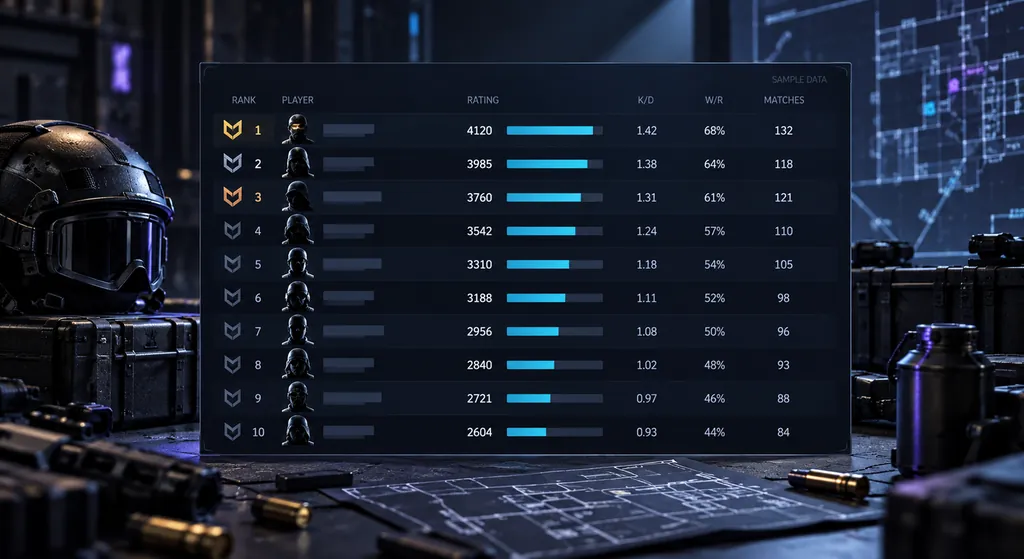
Under the current ranked system, standing comes from Rank Points. Your RP total places you in a rank and division, and a board that sorts by ranked standing lists players from the highest RP down. Players who share a rank are separated by their exact RP, so the order inside a tier can shift after every match.
That is why R6 leaderboards move so much during a season. A short win streak against stronger teams can lift you several places, while a few losses to lower-ranked squads can push you back. Some boards also sort by other measures, such as K/D or total wins, so always check which column a table is sorted by before drawing a conclusion. A board sorted by kills rewards volume of play, which is not the same thing as ranked strength.
Position also depends on who else is playing. A board near the start of a season, or in a smaller region, can look very different from the same board a few weeks later, even if your own results have not changed much.
Regional and Platform Boards
Most Rainbow Six Siege leaderboards are split rather than fully global. The usual splits are platform, region and season, and each one gives a different picture of the same player base. Knowing which split you are looking at is the first step to reading any board correctly.
Board type
What it shows
Best used for
Global
All listed players in one table
Seeing the very top of the game
Regional
Players grouped by region
Comparing yourself with players you meet in matchmaking
Platform
PC, PlayStation or Xbox separately
Fair comparison within one player pool
Seasonal
The current season only
Measuring current form
For most players, regional and platform R6 leaderboards are the more useful view. You will rarely queue into the global top 100, but you meet players from your own region every night. Our Rainbow Six Siege leaderboard guide covers how each split is built.
Example data only, showing how a ranked leaderboard is ordered by RP.
What Champion Rank Signals on R6 Leaderboards
Champion is the highest tier in ranked, and the top of most R6 leaderboards is made up of Champion players. Reaching it takes a long run of strong results against strong opponents, so it is a meaningful marker of skill and consistency within a season.
It is still worth reading with care. Champion covers a wide range of players, from those who have just crossed into the tier to those far ahead of the pack, and the gap between them can be large. A Champion who climbed early may play less later in the season, while a newer arrival is still active. Look at recent matches and win rate as well as the badge.
If you are studying a Champion to learn from, pick one who has played plenty of matches this season, since their habits reflect the current state of the game.
The R6 rank system explained guide covers every tier from Copper to Champion and how RP moves you between them.
Why Leaderboard Rankings Reset Each Season
Ranks reset at the start of every season, so seasonal leaderboard rankings start again too. The reset keeps competition fresh, lets players who improved show it quickly, and stops early leaders from holding a top spot on the strength of old results.
For you, the reset has three practical effects:
The first weeks of a season are noisy. Positions jump around because everyone has played only a handful of matches.
Balance changes, new operators and map updates can shift who performs well, so last season’s order is not a forecast.
Lifetime records survive the reset, so a player’s history still tells you something even when their current spot is low.
Comparing your own place across seasons tells you more than any single snapshot.
To follow your climb from season to season, log a snapshot in the season tracker on the homepage, which saves entries in your own browser. That gives you a personal record that R6 leaderboards alone cannot provide.
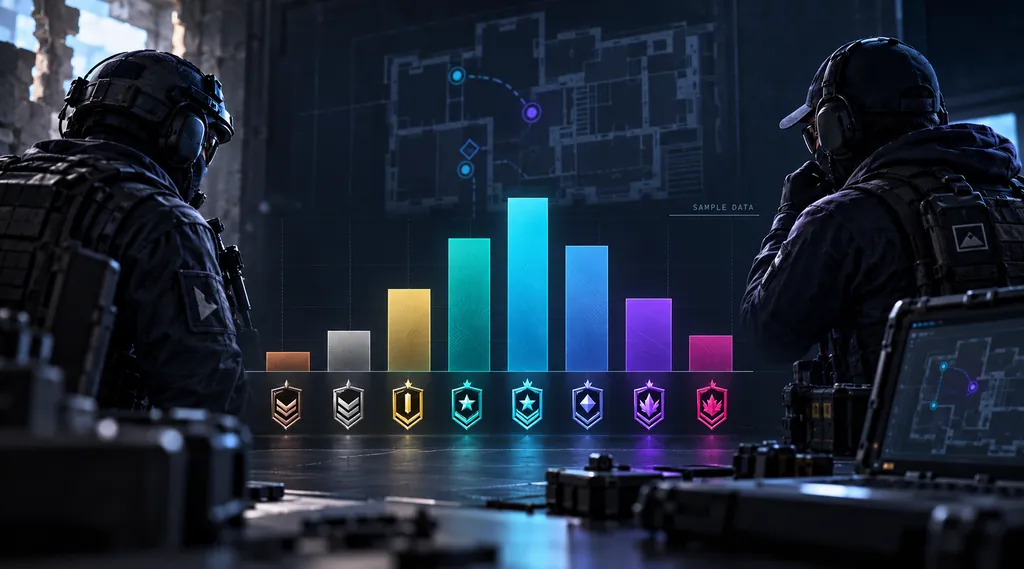
A distribution shows where players sit across tiers, not who is best.
Learning From Top Players on R6 Leaderboards
The best use of a leaderboard is not ranking yourself. It is finding players worth studying. Once you spot consistent names near the top of your region or platform, look for their public content, such as streams, uploaded VODs or tournament matches, and watch with a specific question in mind.
Operator picks. Which operators do they choose on attack and defense, and on which sites?
Utility timing. When do they use drones, gadgets and hard breach utility, early or late in the round?
Positioning. Where do their anchors hold, and how do their roamers buy time?
Decision making. When do they trade, fall back or play for the clock?
Copy one habit at a time and test it over several ranked matches. Our operator stats guide helps you judge whether a new pick actually suits your play, rather than just the player you copied it from.
The Limits of R6 Leaderboards
R6 leaderboards measure results, not the full story. Several things can distort them:
Smurfing. Experienced players on second accounts can sit far above their true level in a low tier, or race through it, which skews what a normal rank looks like.
Sample size. A player with very few matches can post an eye-catching win rate that would not survive a full season.
Stacked squads. A coordinated five-stack can climb faster than the same players would in solo queue.
Boosting and account sharing. Breaking the rules this way can place an account on a board its owner could not reach alone.
None of this makes leaderboard rankings useless. It means a position is one data point. Read it with match count, win rate and K/D in context, as covered in our R6 stats guide, before you decide what a ranking says about a player.
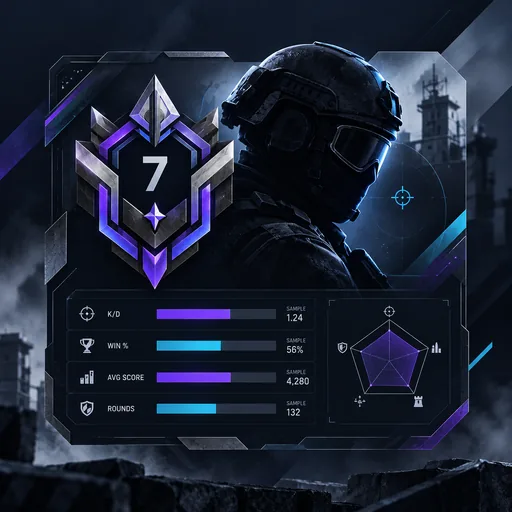
This is a labelled example card, not a real player's profile.
How the Example Cards on This Page Work
The stat cards higher up this page are reference cards, not live entries. Each rank tier card describes a Ranked 3.0 tier and its divisions, each role card explains a common attack or defense job, and each core metric card shows a formula. Any figures on them are example data, chosen to show how the numbers fit together. The squad range and rank position notes, for example, describe how the tiers relate to each other rather than any single account.
The cards cannot pull a real player’s profile, because Siege Tracker has no live data feed, no access to Ubisoft accounts and no player search. That is deliberate. Instead of copying R6 leaderboards from elsewhere, the page teaches you how to read them, so you can open any board and understand what you are looking at.
A leaderboard is a good way to set a target you can measure. Rather than aiming to simply get better, pick a goal tied to a board, such as moving up one division this season or reaching the next tier on your platform. Concrete goals are easier to track and easier to adjust.
Note your starting rank and RP after your first ranked matches of the season.
Check your position on the same board at regular intervals, not after every match.
Record your win rate alongside it, since match results are what move your RP over time.
Review at mid-season and change one part of your game if progress has stalled.
Used this way, R6 leaderboards become a progress check instead of a source of stress. Our guide on how to improve your R6 stats pairs well with this approach.
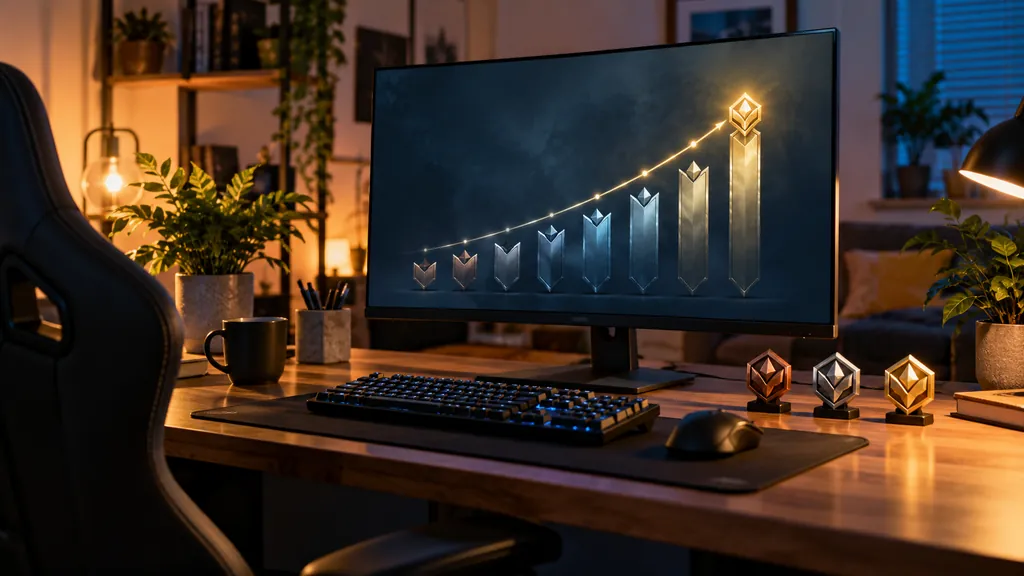
Ranks, divisions and Rank Points together decide ranked standing.
Checking Third-Party Rainbow Six Siege Leaderboards
Many players browse leaderboards on third-party tracker sites as well as in the game. These can be handy, but each site builds its R6 leaderboards from the players it tracks, on its own update schedule and sometimes with its own sorting rules. Two sites can therefore show different leaderboard rankings for the same region on the same day.
Before trusting a board, check the season, platform and region filters, look for a last-updated time, and confirm what the table is sorted by. If a number looks off, compare it with the in-game screen, which remains the original record. Treat Rainbow Six Siege leaderboards on outside sites as a helpful view of trends, and the game itself as the final word on exact positions. Our data accuracy page explains why sources disagree and how to check a figure yourself.
Analyze Your Own R6 Stats
Open the Siege Tracker Stat Analyzer to turn your own kills, deaths, wins and losses into K/D, win rate and headshot %. No account needed, and we will never ask for your password.