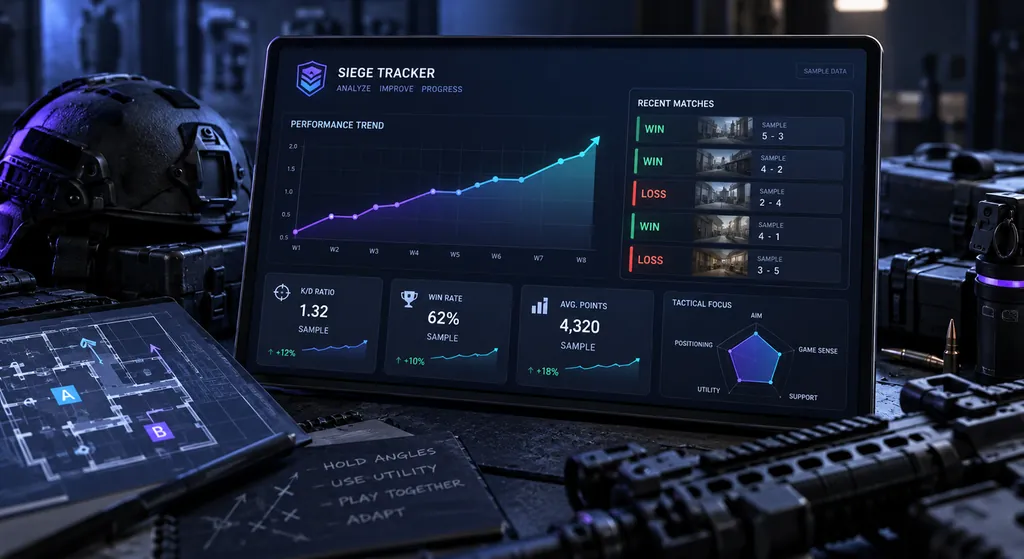
Better numbers come from better habits, not luck. This Siege Tracker guide shows how to improve R6 stats by setting a baseline, reading what your K/D, win rate and operator stats reveal, and practicing the skills that move them.
Guessing what to fix wastes playtime. Measuring first shows exactly where your Rainbow Six Siege rounds are being lost.
Focused Practice
Your stats point at the skill that needs work. A low headshot % says aim and crosshair height, a weak win rate with a decent K/D says round decisions and utility, and poor map stats say map knowledge. Practicing the right thing gets results far faster than simply playing more matches.
An Honest Feedback Loop
Practice without measurement is guesswork. When you set a baseline and re-check the same metrics after each block of ranked matches, you see which changes actually helped. Numbers that rise and stay up confirm a habit is working; numbers that do not move tell you to adjust the plan.
Steadier Rank Progression
Rank Points follow wins, and wins follow the small habits that keep you alive and useful to your team. Improving trading, utility and comms tends to lift win rate first, which in turn drives more consistent rank progression from season to season.
Follow these steps to turn your current Rainbow Six Siege stats into a clear, measurable improvement plan.
Establish Your Baseline 01
Before changing anything, record where you stand. Copy your current-season kills, deaths, wins, losses, headshots and matches played from the in-game career screen into the Stat Analyzer and save the results with the date and rank. This baseline is the reference point for every comparison that follows, so use ranked-only numbers if ranked is where you want to improve.
Review Your K/D Ratio 02
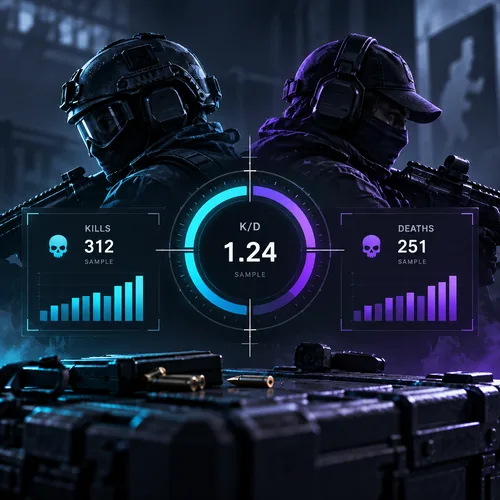
K/D shows how often you win your gunfights. A K/D around 1.0 means you trade roughly evenly; well below it usually points to dry peeks, poor crosshair placement or taking fights without support. Compare your ranked K/D with your overall K/D: a big gap often means you play differently under pressure. Note which kind of deaths repeat most often.
Analyze Your Win Rate 03
Win rate is the stat most closely tied to Rank Points. Calculate it as wins ÷ (wins + losses) × 100. If your K/D is solid but win rate is low, your kills may be coming too late or in rounds that are already lost. If win rate is high with a modest K/D, you are probably contributing through utility and positioning. Both readings point to different practice priorities.
Study Operators & Maps 04
Look at which operators and maps produce your best and worst results. Operator stats show where your playstyle fits; map stats show where knowledge gaps cost you rounds. Pick two or three operators per side and focus on the maps in the current ranked pool where your win rate is lowest.
Build a Practice Routine 05
Turn your findings into a short routine. Warm up aim before ranked, drill crosshair placement at head height, learn one new utility lineup or rotation per map, and set one focus per session, such as trading every teammate death or calling every enemy you spot. One clear goal per session beats trying to fix everything at once.
Track Your Progress 06
After every block of ranked matches, enter your new numbers into the Stat Analyzer and compare them with your baseline. Look for direction over several checkpoints instead of reacting to one session. When a metric improves and holds, keep the habit and move your focus to the next weakest stat. Keep seasonal and lifetime stats separate so old data does not hide real progress.
Core Habits for Better R6 Stats
Four habits that improve Rainbow Six Siege stats the most, and the metrics that show whether each one is actually working.
Crosshair Placement
Keep your crosshair at head height and pre-aim the angles where enemies are most likely to appear. Good placement means less flicking, faster first shots and more opening duels won. When this habit sticks, your headshot % climbs first, followed by a steadier K/D ratio. Practice it in every round, not just in aim trainers, and check whether your headshot % holds across several sessions.
Smarter Utility Usage
Gadgets and grenades win rounds that raw aim cannot. Use utility to clear corners, deny plant spots, slow pushes and support teammates rather than saving it until the round is lost. Better utility usage rarely shows up in K/D, but it shows clearly in win rate. If your win rate rises while K/D stays flat, your utility is doing its job.
Trading Kills With Teammates
Play close enough to a teammate that if they die, you can immediately punish the enemy who killed them. Trading turns a lost duel into an even exchange and stops rounds from collapsing into 4v5s. In your stats, good trading shows as fewer isolated deaths, a K/D that holds near or above 1.0, and a higher win rate in close rounds.
Clear Communication
Call enemy positions, your own utility and your plan in short, specific callouts. Good comms help the whole team take better fights, which means more round wins even when your personal numbers stay the same. Track win rate when you play with consistent comms compared to silent solo queue sessions; the difference is often larger than any individual stat change.
Practical routines that help Rainbow Six Siege players improve their stats and rank progression season after season.
Review Your Replays
Watch your deaths back from your own view and the enemy's where replays are available. Look for repeated mistakes such as wide peeks, late rotations or reloading in the open. Fixing one recurring death protects your K/D every round.
Warm Up Before Ranked
Spend ten to fifteen minutes on aim and recoil control before your first ranked match. Starting sharp reduces early-session losses that drag down both K/D and win rate, and helps your Rank Points hold steady from the first game.
Fewer Operators
Master two or three operators per side instead of rotating through the whole roster. A smaller pool builds reliable habits faster and makes your operator stats meaningful enough to compare from one week to the next.
Learn Key Map Sites
Pick your weakest map in the ranked pool and learn its common sites, spawn peeks and rotation holes. Map knowledge lifts win rate quickly because you lose fewer rounds to angles you never expected.
Manage Tilt and Fatigue
Set a stop rule, such as ending the session after two straight losses. Tired or tilted play produces the long losing streaks that cost the most Rank Points and skew your session stats.
Queue With a Duo
Playing with a consistent partner makes trading and communication far easier. Compare your win rate with and without a duo to see how much coordinated play is worth to your rank.
How to Improve R6 Stats | A 4-Week Plan, Drills and Proof It Works
This section takes how to improve R6 stats from general habits to a concrete schedule. You will find a four-week plan, specific drills for aim, peeking and droning, a simple review routine, ways to manage tilt, and a fair method for checking whether your numbers really moved.
In this guide
A 4-Week Plan for How to Improve R6 Stats
Trying to fix everything at once is the fastest way to fix nothing. A four-week plan gives each skill its own focus while you keep playing ranked normally.
Week 1 – Baseline and aim. Record your starting numbers, then add a short aim warm-up before every session.
Week 2 – Peeking and positioning. Focus on how you take fights, not just whether you hit shots.
Week 3 – Information and utility. Drone more on attack, use cameras on defence, and spend gadgets earlier.
Week 4 – Teamplay and review. Work on trading distance and review your worst rounds.
At the end of each week, record a checkpoint with the same playlist and filters. That is how to improve R6 stats in a way you can actually measure, because every week has one clear goal and one clear comparison.
Building a Shooting Range Aim Routine
The in-game Shooting Range lets you practise with the weapons and sensitivity you actually use in matches, which makes it more relevant than many outside aim tools. Keep the routine short so you do it every day rather than once a week.
Head-height tracking. Move along a wall while keeping your crosshair level with where a head would be.
First-shot accuracy. Reset, then fire single taps at targets at different distances.
Recoil control. Spray at a fixed point with your main weapon and its attachments until the pattern feels familiar.
Transfers. Switch between two targets, focusing on stopping cleanly on each one.
Ten minutes is enough. Stop once your accuracy feels consistent, because practising tired builds sloppy habits. When you plan how to improve R6 stats tied to aim, watch your headshot % over the following weeks.
A steady upward trend over weeks matters more than one standout match.
Peeking Habits That Protect Your K/D
Many lost duels have nothing to do with aim. They come from how and when you peek. Small changes here often lift K/D faster than any drill.
Clear angles one slice at a time. Move gradually around a corner so you face one possible enemy position at a time, not three.
Shoulder peek for information. Show a sliver of your body to draw a shot or spot an enemy, then decide whether to commit.
Never re-peek the same angle the same way. The enemy is now pre-aimed. Change height, timing or angle, or reposition.
Peek with a reason. Only take a fight when you have information, a teammate ready to trade, or the round demands it.
Pair these with steady crosshair placement and you give opponents fewer free kills. The K/D ratio explained guide shows what a change in K/D actually means.
How to Improve R6 Stats With Droning and Information
Information decides which fights you take, and the fights you choose shape every number on your profile. If you want to know how to improve R6 stats without touching your aim, start by gathering better information.
On attack, drone the room you are about to enter, not just the objective. Keep a drone for later in the round so you can clear a flank or find the last defender. On defence, check cameras between rotations and call what you see in short, exact terms.
Before you peek, ask yourself what you know about the enemy positions. If the answer is nothing, gather information first. This habit often lowers deaths more than raising kills, which still improves K/D, and it lifts win rate because your team plays with fewer surprises.
Better peeking habits show up as more duels won and a steadier K/D.
Trading Spacing and Team Roles
Trading only works if you are in the right place when a teammate dies. Too close and one grenade or spray catches you both. Too far and the enemy resets before you arrive. Aim to be one short step behind your teammate’s line of sight, ready to swing the same angle.
Agree on roles before the round starts. An entry player takes the first contact, a second player trades, and support players hold utility for the plant or the push. When everyone knows their job, the numbers improve across the team.
Measure this by comparing your win rate in rounds where your team stayed together against rounds where players spread out. Even a rough note after each session will show the pattern. Good trading is a big part of how to improve R6 stats as a group.
How to Improve R6 Stats Through Replay and VOD Review
Reviewing your own play is the most honest coach you have. Use the in-game match replay where it is available on your platform, or record your own gameplay. Keep each review session short and structured so it does not turn into passive watching.
Pick one match that felt bad, not one you won comfortably.
Jump straight to each of your deaths and pause a few seconds before it.
Ask three questions. What information did you have? Who could trade you? Was there a safer option?
Write one sentence per death and look for repeats.
Choose the single most common mistake as next week’s focus.
Five deaths reviewed carefully are worth more than five matches watched at full speed. Knowing how to improve R6 stats often comes down to spotting the same mistake three times and finally fixing it.
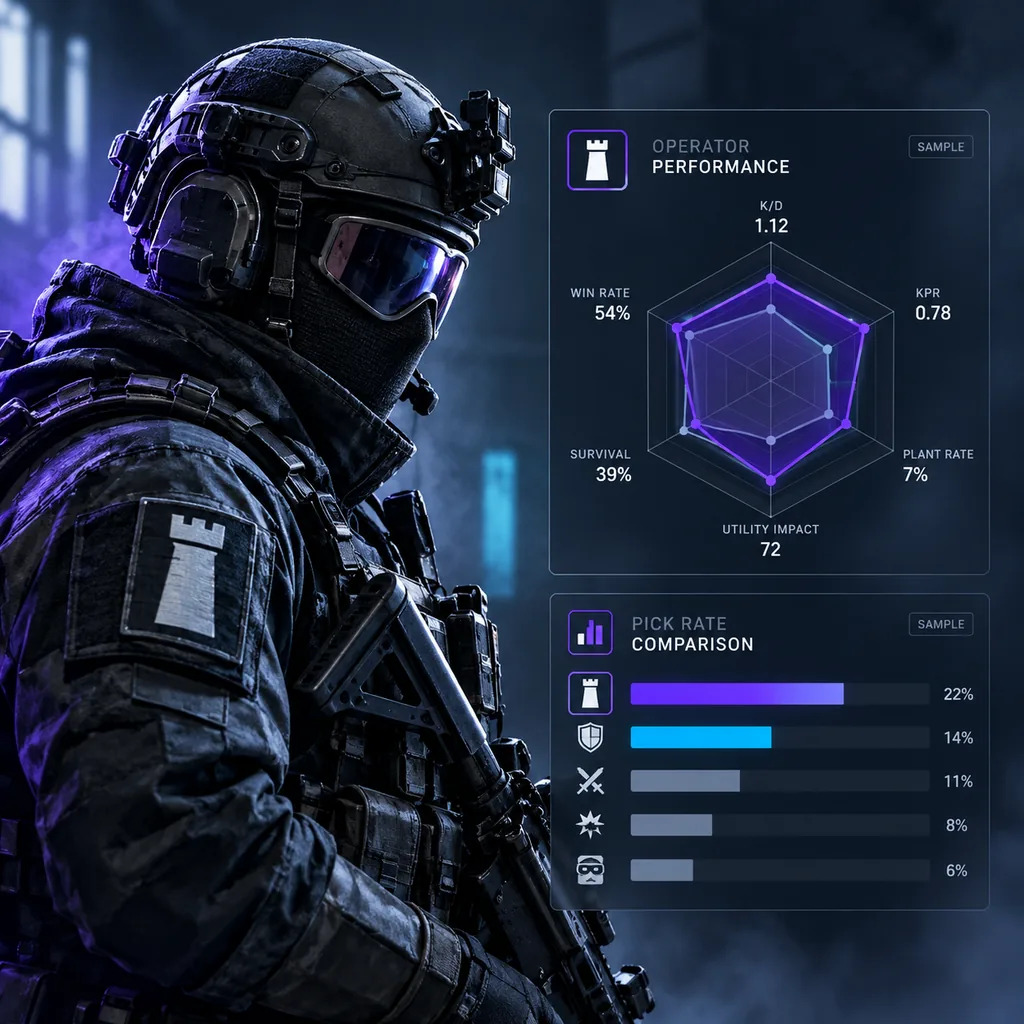
A radar view highlights which operators carry your results and which lag.
Deepening Your Operator Pool the Right Way
A small operator pool helps, but only if you learn each operator properly. For every operator you main, know where their gadget is most useful on each ranked map, which weapon and attachments suit your playstyle, and what role they fill in your team.
Practise one operator at a time for a full week. Track the rounds you play on them separately, so their numbers are not mixed with your other picks. Over time, a performance profile forms for each operator and shows where your strengths actually are.
If an operator stays weak after a fair sample, swap them for another that fits the same role. The operator stats page explains which numbers to compare, so you can judge picks on evidence instead of how a single round felt. Building depth like this is a patient but reliable answer to how to improve R6 stats on the operators you play most.
Mental Game and Tilt Control
Tilt is the hidden stat killer. A frustrated player takes riskier fights, communicates less and stops using utility, so K/D and win rate fall together. Managing your mood is a real part of how to improve R6 stats.
Reset between rounds. Take one breath and name the next thing to do, not the last thing that went wrong.
Mute what drags you down. Muting a toxic player is better than arguing for three rounds.
Keep a stop rule. Decide in advance when a session ends, and respect it even after a win.
Separate outcome from decision. A good play that fails is still a good play. Judge the choice, not the result.
Notice when your sessions go wrong. If losses cluster late in long sessions, shorter sessions may lift your numbers more than any drill.
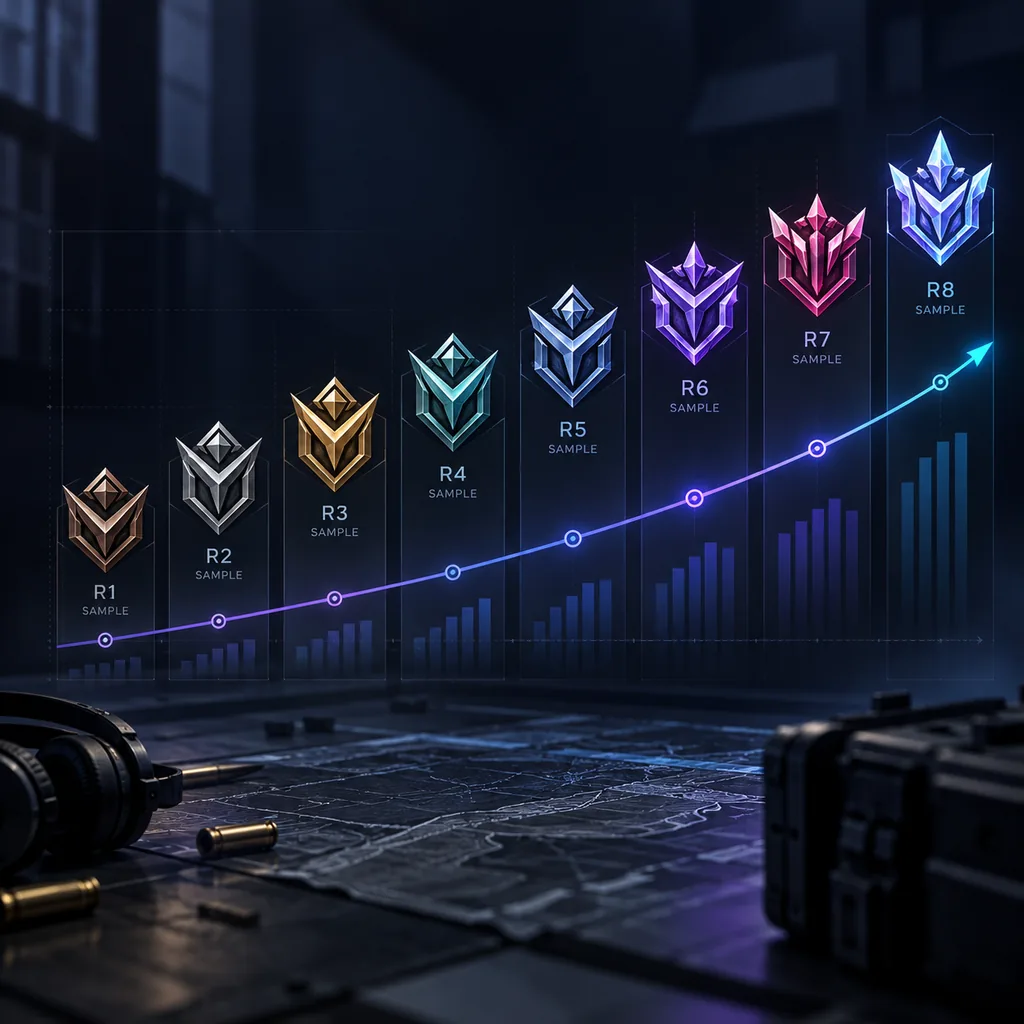
Consistent wins, not single high-kill games, move you up the rank ladder.
Turning Better Stats Into Rank Points
Better stats matter because they lead to more wins, and wins drive Rank Points. In the current ranked system, RP is gained or lost each match, and ranks run from Copper up to Champion before resetting each season. A season of steady small gains usually beats a few high-kill games followed by long losing streaks. Focusing on wins is how to improve R6 stats in a way that shows up on your rank, not just your K/D.
That is why consistency is worth more than peak performance. Playing at your normal level every session, avoiding tilted queues and keeping a reliable operator pool all protect RP over time.
The final step is checking whether your plan really changed anything. Compare your week-four checkpoint against your baseline using the same playlist, platform and filters. Enter both into the Stat Analyzer or the K/D & Win Rate Calculator so the formulas stay identical.
As a worked example, if your baseline was 90 kills and 100 deaths (K/D 0.90) and four weeks later you have 105 kills and 100 deaths over a similar number of matches, K/D is now 1.05. That is a real shift, but confirm it holds for another few weeks before calling it permanent. If the numbers have not moved, that is useful too. Go back to your review notes, pick the next most common mistake and run another four-week block.
Keep logging with the method in how to track R6 stats, and you will always know how to improve R6 stats next.
A Weekly Checklist to Improve R6 Stats
If you only keep one habit from this guide, make it this short weekly review. It is the simplest way to improve R6 stats without guessing.
Log your R6 stats at the same point each week: kills, deaths, wins, losses and rank.
Compare against last week and your baseline, not against one great or terrible match.
Pick one focus, such as trading, droning or one weak map, and ignore the rest for now.
Practice that focus in the Shooting Range or in casual matches before you queue ranked.
Recalculate your R6 stats with the KD calculator and write one sentence about what changed.
Note the R6 stats that did not move as well, because a flat number is still useful data.
Repeat the loop for a month and keep every entry, so your R6 stats history stays honest. Small, measured changes are how players improve R6 stats season after season, and your log shows you exactly which habits worked.
Start Improving Your R6 Stats Today
Set your baseline in the Siege Tracker Stat Analyzer, then check back after each week of focused practice. It runs in your browser, nothing is stored, and we never ask for your password.